AuRA
How It Works
How AuRA researches a story on its own, with DeepResearch deciding what to look up and DeepThink writing and answering its own questions.
AuRA doesn't answer a question. It is handed something to think about, such as a news story, a feed or a broad goal, and works out for itself what it needs to know, what it should ask and what it should say.
Recipes
Every run follows a recipe: an ordered list of sections, each with a prompt, a function and instructions for what happens to the result. A section can be spoken, written into the research document, both, or kept internal as working data. Prompts are templates. They can pull in the source article, the research gathered so far, earlier results, and everyday context such as the day of the week, so the agent's own output keeps feeding the next prompt.
Recipes are where audience lives. A medical recipe writes for physicians and researchers; a children's recipe outlines a story about a young heroine and tells it for five-to-eight-year-olds; a finance recipe writes for investors. The research machinery underneath is the same. That's how one study could become a plain-language video for a waiting room and a technical briefing for the physician.
DeepResearch
DeepResearch handles everything the agent doesn't already know.
- After reading the source, the agent is asked for a list of search terms that would flesh out its understanding, including the people and organizations involved. How many is a setting, the DeepResearch result limit.
- The list comes back as structured JSON. With local models, a grammar constrains the output so it can only produce a valid list.
- Each term becomes a search. AuRA fetches the top results, web pages and PDFs alike, skips sites on a blocked list, trims anything too long for a local model's context, and condenses what it read into a background section for that topic.
- Every source is recorded, so the finished report carries a bibliography per topic.
The search results go back into the prompt as retrieval-augmented generation (RAG), which keeps the writing tied to what the sources say rather than what the model remembers.
DeepThink
DeepThink is the self-prompting half. Given the story and the research, the agent writes its own series of prompts, as many as the DeepThink depth setting asks for, each one an aspect worth discussing. Then a separate stage runs those prompts one at a time, writing a section for each while avoiding repetition and staying inside what the research supports.
The agent decides what questions to ask, what information to seek and what it needs to answer. We direct the focus; the analysis is its own.
In the Sustainable Development Goals recipe the chain goes further. The agent lists categories of technology, lists the goals, chooses one, invents a combination of technologies to address it, researches that invention, and writes a five-part analysis of it. Then it critiques its own idea: where it is weak, what makes it hard to implement, and which populations might be harmed by it. That last step, asking who gets hurt when you fix something, came out of the earliest experiments and stayed in the design.
These are RAG, prompt chaining and Tree-of-Thought patterns, with one difference from the usual use: the agent generates its own chains and thought trees instead of following ones we wrote.
From research to production
Once the writing is done, the same recipe carries on into production:
- Titles and metadata. The agent writes a YouTube title, a teaser description that asks questions the episode answers, and tags.
- Voice and video. Spoken sections go to text-to-speech, and a presenter is lip-synced to the narration. See Voices and Avatars.
- Assembly. Title clips, transitions and a closing tag are cut around the presenter, normalized to one frame rate and audio format so the pieces merge cleanly.
- Publishing. The episode uploads with its metadata and a link to its research background.
The research document
Every run can also write an HTML research document that shows its work. Each one has the same sections: the source article, the finished video, a Research section with one entry and bibliography per DeepResearch topic, the full Transcript, a Deep Thought section with each self-generated prompt and its answer, and a high-level background overview. The reports run to many thousands of words and dozens of linked sources. A selection is on Outputs.
Watching it work
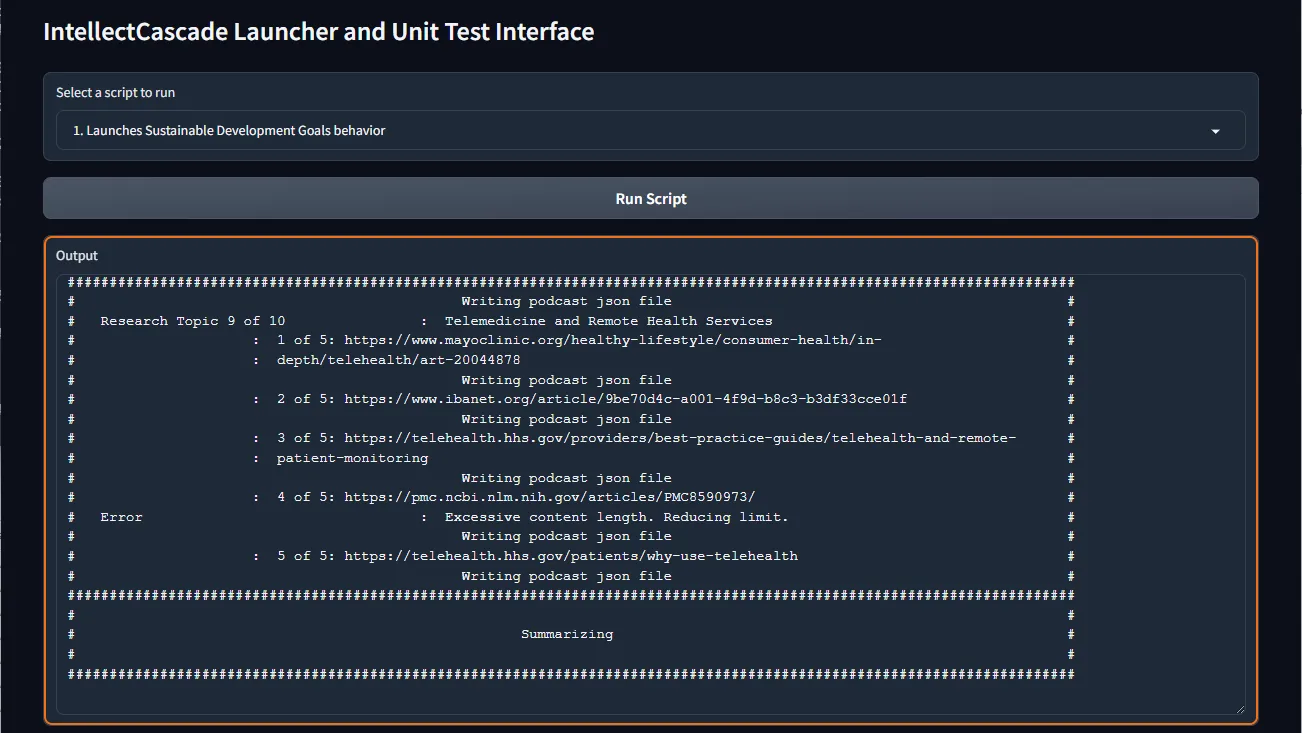
Runs are long, so the system reports constantly: the research topic it's on, each source it's reading, how far through the list it is, and anything it had to cut. The launcher and the AuRA interface both show that log live, which made it practical to tune recipes by watching the agent think.
Gallery
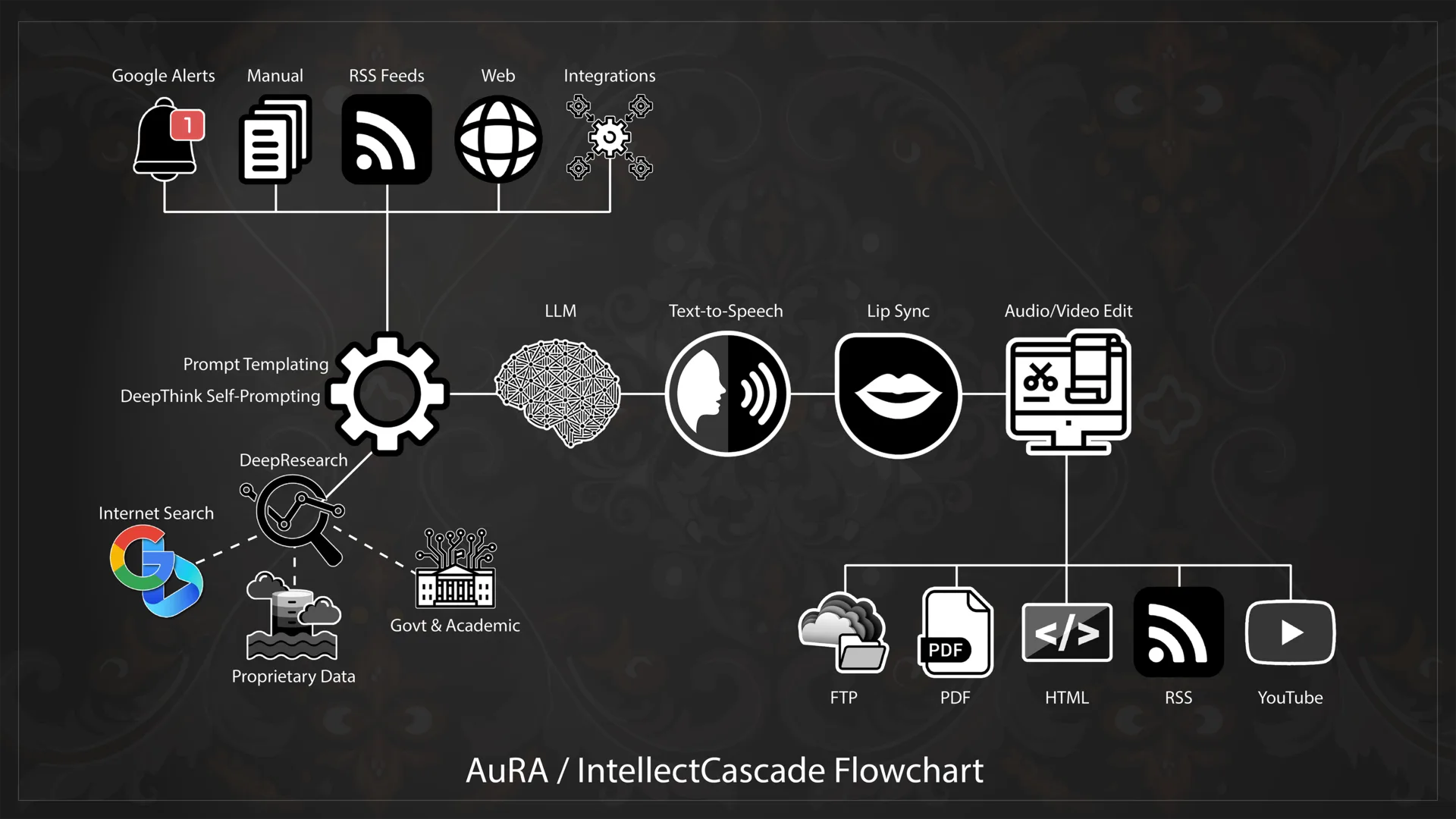
The research and production pipeline as one diagram. 
DeepResearch result limit and DeepThink depth were sliders in the AuRA interface. 
Related work
-
NewsPod AI
A news video podcast that researches, records and publishes itself.
-

AI Storybook
News stories, autonomously retold for children.
-

AuRA Avatar Generator
Customizable, photorealistic presenters for AI-generated video briefings.
-

b2c3d
Traditional 3D content creation, rebuilt with AI inside the tools.