Computational Optics
The Lab
The ISO-5 cleanroom, the optical bench and the instruments we use to make spectral measurements that repeat.
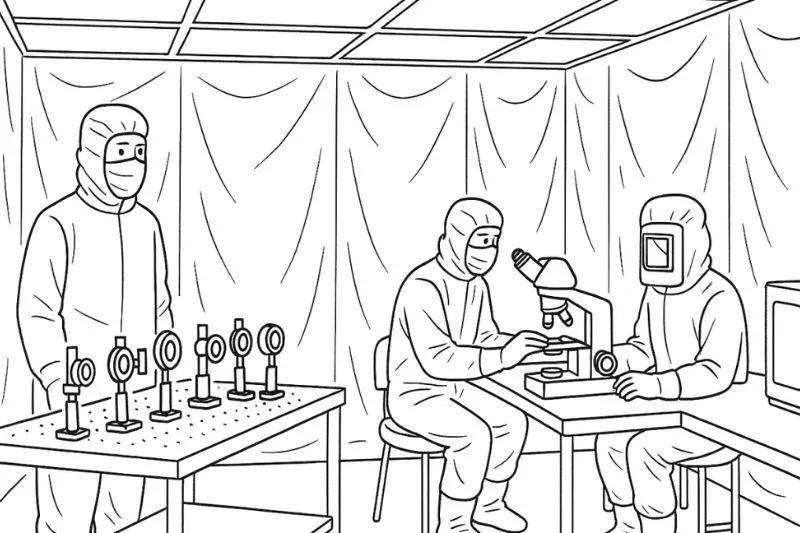
Spectral measurements are unforgiving. Dust on a filter, a drifting lamp, a reflection off a white wall or a few degrees of temperature change all show up in the numbers. To make measurements we can repeat next week and trust in a training set, we built a dedicated room for them: the ISO-5 Optical Cleanroom.
The room
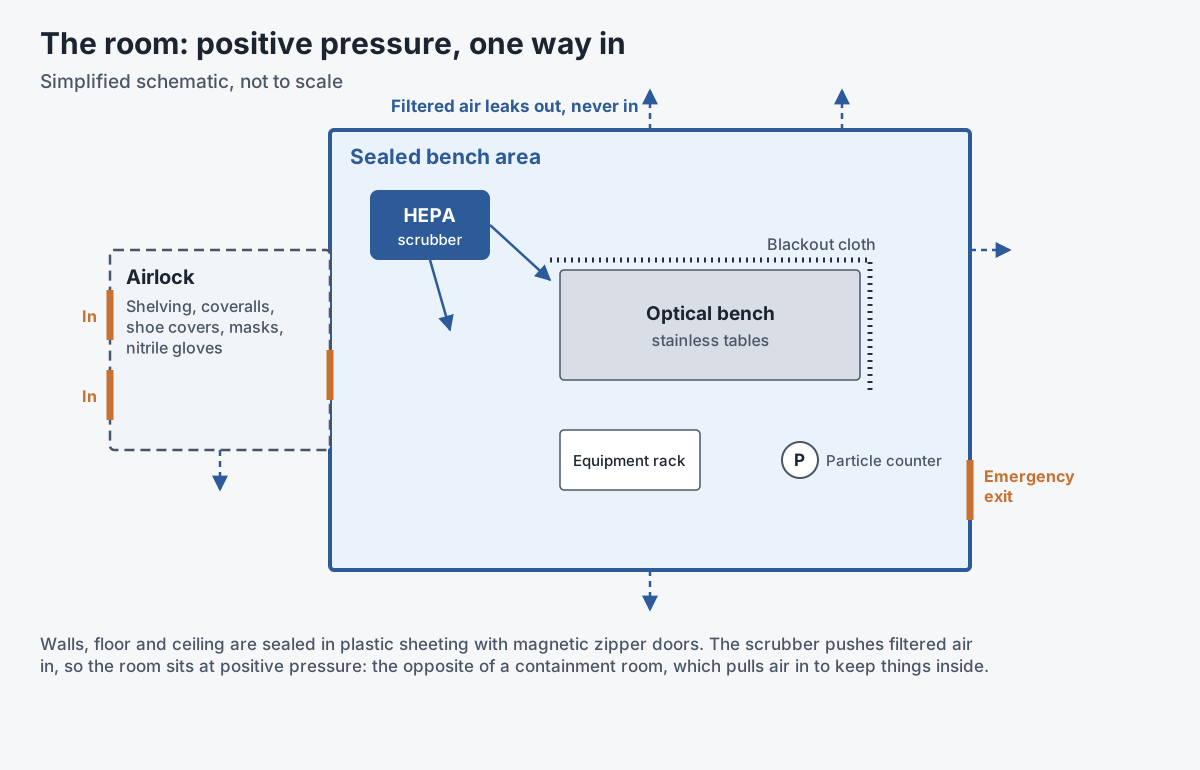
The cleanroom is built for ISO Class 5 conditions, the old Class 100: no more than about 100 particles of half a micron or larger per cubic foot of air. It runs at positive pressure, so air leaks out rather than in, and HEPA filtration scrubs what's inside. Entry is through an airlock. Temperature and humidity are held steady, which matters for both the optics and the sensors under test.
Inside, everyone wears coveralls, booties and 10 mil nitrile gloves. Blackout cloth (Duvetyne) around the bench kills stray light and reflections. Because the sources reach into the ultraviolet and infrared, the lab keeps two kinds of safety glasses: UV-rated (90 to 490 nm) and IR-rated (808 to 1610 nm).
We built the room inside our existing space, with dust-barrier walls, zippered doors and a three-stage HEPA air scrubber, then tuned it for airflow and particle counts.
The bench
The bench is modular, so test assemblies, imaging rigs and sensor fixtures can be swapped without rebuilding the setup.
Light. A tungsten-halogen spectroscopy illuminator gives a smooth, continuous spectrum from about 360 to 2400 nm.
Wavelength selection. Two manual Mini-Chrom monochromators, 300 to 800 nm and 500 to 1200 nm, each with a 100-micron slit set and SMA slit adapters. Together they cover the near-ultraviolet through the near-infrared with overlap in the middle.
Filtering. OD 2 long-pass filters, 12.5 mm, with cutoffs from 400 to 850 nm, for order sorting, stray-light suppression and edge checks.
Delivery. SMA fiber-optic patch cords, 100-micron core, in UV/visible and visible/near-infrared versions, with collimators.
References. Spectralon diffuse white reflectance standards, a Calibrite ColorChecker Digital SG with published reflectance values, and checkerboard calibrators for geometry.
Cameras. Phones under test, mounted with every automatic feature locked, and the reference spectral camera with its prism-optimized lens and beam splitter for paired capture.
Motion. A robot arm with our own control software, and a custom six-axis fixture for mounting two cameras on it.
Equipment lives on a 19-inch mobile rack so it can be rearranged around the bench.

What it lets us measure
With that kit we measure sensor spectral response, optical throughput, lens and filter behavior, and the spectral signatures of materials across the visible and near-infrared, and we can repeat each measurement under the same conditions. That's the foundation for characterizing sensors and for the calibration half of learning the spectrum.
More than one project
The cleanroom has its own page, ISO-5 Optical Cleanroom, because it serves more than this invention. It ties our GPU-accelerated AI work, XR prototyping and spatial computing to physical measurement and calibration, so the data our models learn from is data we can trust. It's one of several specialized spaces we work across, alongside an XR lab, a GPU compute bench and a fabrication workshop, and we're open to a limited number of collaborations with partners in precision imaging and measurement.
Directions for the lab
Directions for the lab include more monochromator capacity, automated optical-path alignment, better spectral reference standards, an integrating sphere for uniform illumination, and integrated end-to-end sensor-testing workflows that take a device from mounting to a finished profile without hand steps in between.
Related work
-
ISO-5 Optical Cleanroom
A cleanroom lab built to turn phone cameras into spectral instruments.
-
CameraSmartPlate
A camera plate that knows where it is, for tracking, virtual production and NeRF capture.
-

HoloFlect
A modular, upgradeable AR headset platform built for enterprise.
-
xR Ecosystem
A modular, device-agnostic programming interface for mixed reality.