QIE Studio
An image generation and editing studio, built by an AI agent working unattended from our specification.
 Eddie OffermannSpecification author and experiment designer
- Role
- Specification author and experiment designer
- Areas
- AI, Tools, Apps, VFX

QIE Studio is two projects in one repository: an application, and a record of how an AI agent built it.
The experiment
The interesting question isn't whether an AI can write code. It's what it takes to hand an AI a real, non-trivial product and have it deliver on its own, with judgment. We split the responsibilities deliberately:
- We wrote a contract, not a transcript. A detailed specification covers the product's behavior, user workflows, data model, API surface, deployment and the required stack (Python, FastAPI, PostgreSQL, PyTorch with diffusers, and a React, Tailwind and shadcn front end).
- The agent owns every decision the spec doesn't make. It's authorized to resolve gaps and trade-offs without waiting for us, on one condition: disclosure. Each original decision is recorded with its context, the alternatives weighed, the research consulted, the choice and the outcome.
- The run is unattended and accountable. The agent keeps a timestamped, commit-stamped progress diary designed to be resumable after a crash or power loss.
The main branch holds only the specification and process documents, so the experiment can be reproduced. Each build lives on its own branch with the generated application and its diary. Our whole input to the run was one instruction, shown above.
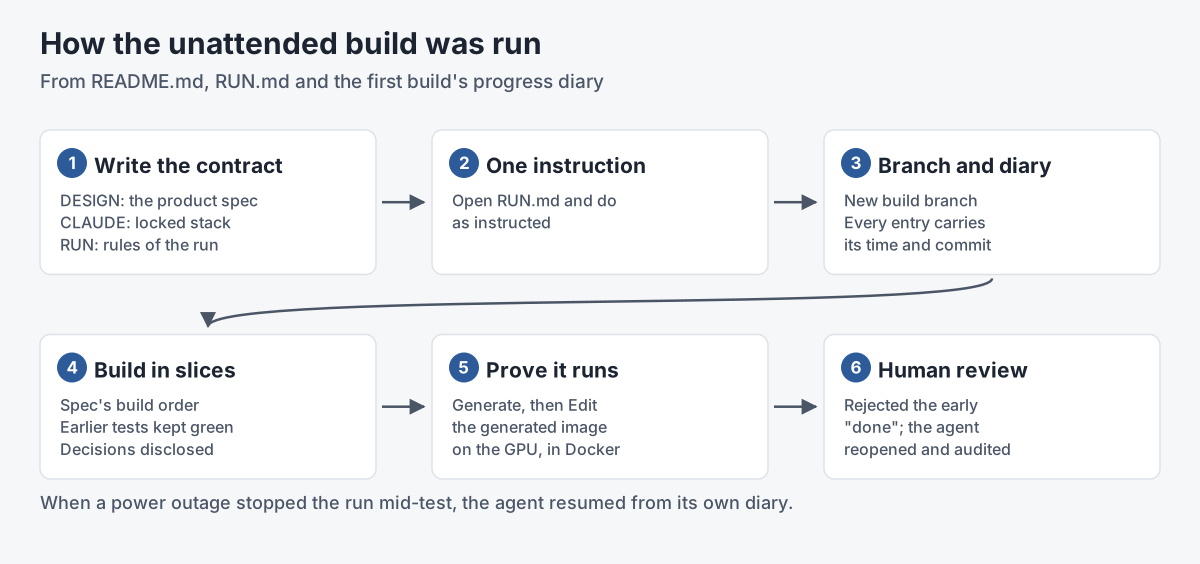
The diary from the first run opens with a banner the agent added at our request. It had declared the work done, ticked off the definition of done, and moved on. Our review found real gaps, and we had the agent record plainly that it called it finished too soon and that a human caught it. That lesson, that an agent's self-assessment of "done" is not the same as done, is as much a result of the experiment as the code.
The application
QIE Studio is a self-hosted, Docker-deployable studio built around the Qwen-Image model family: Qwen-Image for text-to-image generation and Qwen-Image-Edit for instruction-based, multi-image editing.
- Generate and Edit modes share one workflow.
- A library of reusable images and named prompts, where a prompt can pin some images and leave open slots to fill at run time, such as a fixed room photo plus uploaded furniture to stage in it.
- LoRA installation and stacking from local files, Hugging Face, CivitAI or a URL.
- Guided resolution presets, and a VRAM-aware advisor that recommends bf16, fp8 or int4 precision for the available hardware.
- Live latent previews, batches and sweeps, and a reproducible history of every job.

It targets NVIDIA, AMD and Apple Silicon hardware, runs single-user and local, and is designed to open up to multi-user and cloud deployment.
Links
Sources
Related work
-

AuRA Avatar Generator
Customizable, photorealistic presenters for AI-generated video briefings.
-

b2c3d
Traditional 3D content creation, rebuilt with AI inside the tools.
-

BigBlueBam and the B-Suite
A work suite where AI agents work alongside people, with the same permissions.
-
ToolForge
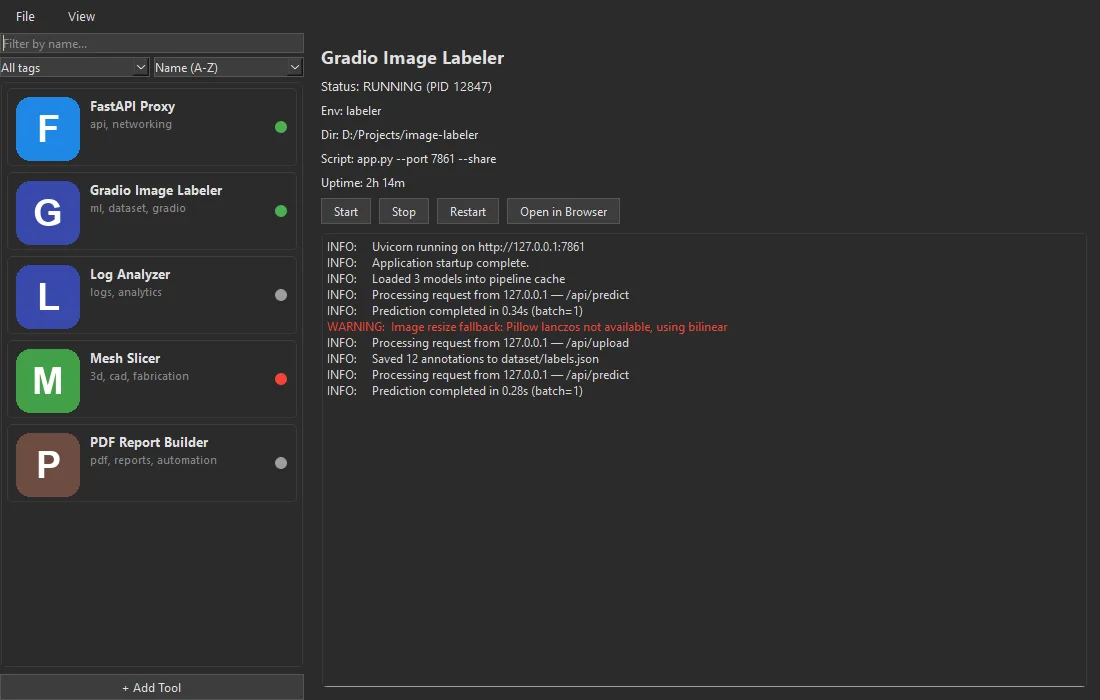
A desktop launcher for local Python tools that AI agents can drive over MCP.